Choledocholithiasis
Common bile duct stone causing biliary obstruction — may be asymptomatic or present with colic, jaundice, or cholangitis
Symptoms / Associated Sx
RUQ or epigastric pain (colicky, postprandial)
Jaundice, dark urine, pale stools (biliary obstruction)
Pruritus (conjugated hyperbilirubinemia)
Fever if secondary cholangitis develops
Denies
High fever + rigors + hypotension (rules out cholangitis if absent — lower urgency for ERCP)
Weight loss, anorexia (rules out malignant biliary obstruction if absent)
Pain radiating to right shoulder (reduces isolated CBD stone likelihood)
Social History (SHx)
Known gallstones, prior cholecystectomy (retained/recurrent CBD stone), obesity, female, age >40, rapid weight loss, prior biliary surgery or ERCP.
Main Etiology
Secondary CBD stones (migrated from gallbladder — most common)
Primary CBD stones (de novo in duct); recurrent post-cholecystectomy
Bile duct stricture → bile stasis → stone formation
Most Common DDx
Acute cholangitis (CBD stone + infection → Charcot's triad; fever + jaundice + RUQ pain; WBC elevated; CBD dilation; ERCP is urgent)
Acute cholecystitis (cystic duct obstruction — RUQ pain + fever + positive Murphy's; bilirubin/ALP may be mildly elevated but CBD not dilated; wall thickening on US)
Malignant biliary obstruction — pancreatic head cancer or cholangiocarcinoma (painless jaundice + weight loss; progressive; CBD dilation with mass on CT/MRCP; no stones)
Primary sclerosing cholangitis (PSC) (strictures without stone; young male with IBD; beaded/pruned-tree appearance on MRCP; ALP >> bilirubin)
Acute pancreatitis with biliary etiology (ALT >3× ULN; lipase >3× ULN; CBD stone often present; overlapping presentation)
Mirizzi syndrome (external CBD compression by gallstone in cystic duct/Hartmann's pouch — appears like CBD obstruction but stone is extrinsic; CT/MRCP distinguishes)
DATA
LFTs (elevated ALP, GGT, bilirubin — cholestatic pattern); CBC (WBC if cholangitis); lipase, amylase (if pancreatitis)
PT/INR; BMP (renal function)
RUQ ultrasound (CBD dilation >6–8 mm + gallstones); MRCP (first-line for suspected CBD stone); EUS; ERCP (therapeutic)
Home Meds
Anticoagulants (hold before ERCP; INR <1.5 for procedure)
Antiplatelets (hold 5–7 days before ERCP)
Plan
NPO; IV fluids; pain management (ketorolac, opioids PRN)
ERCP with sphincterotomy and stone extraction:
Urgent (<24h): concurrent cholangitis or severe pancreatitis
Elective (24–72h): uncomplicated choledocholithiasis
Indomethacin 100 mg PR immediately after ERCP (reduces post-ERCP pancreatitis risk ~50%)
Antibiotics if cholangitis suspected (see cholangitis section)
Cholecystectomy: same hospitalization or within 2–4 weeks after ERCP and stone clearance
Monitor LFTs/bilirubin post-ERCP; trend CBC, BMP daily; GI/surgery consult; PT/OT if prolonged
Discharge: Low-fat diet; surgery follow-up for cholecystectomy within 2–4 weeks; LFTs recheck in 2 weeks; return precautions: fever, recurrent jaundice, severe RUQ pain
Red Flags
Charcot's triad (fever + jaundice + RUQ pain) → cholangitis → urgent antibiotics + ERCP within 24h
Reynolds' pentad (+ hypotension + AMS) → severe cholangitis → ICU + emergent ERCP
Post-ERCP fever or rising bilirubin → retained stone or cholangitis → repeat imaging + ERCP
Rising lipase post-ERCP → post-ERCP pancreatitis → aggressive IVF, analgesia
Painless jaundice + weight loss without stone → malignant obstruction → CT/MRCP urgently
Senior IM Resident Pearls
ASGE high-probability criteria (any one): bilirubin >4, CBD stone on US, clinical cholangitis → proceed directly to ERCP; intermediate → MRCP or EUS first
Indomethacin 100 mg PR post-ERCP — guideline-recommended; reduces post-ERCP pancreatitis by ~50%
MRCP sensitivity ~90–95% for CBD stones — excellent non-invasive first step for intermediate probability
Common mistake: Skipping cholecystectomy after ERCP — recurrence rate 10–15%/year without it
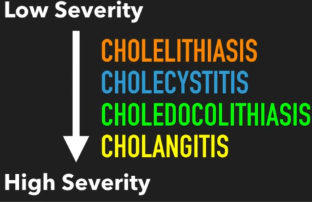
ORDERS
Labs
Admission Labs
CBC with diff
CMP
BMP
LFTs (AST, ALT, ALP, GGT, total/direct bilirubin)
PT/INR
PTT
Lipase
Amylase
Magnesium
Phosphorus
Additional Labs
Blood cultures ×2 (if fever/cholangitis concern)
Lactate (if sepsis concern)
Type & Screen if unstable
CA 19-9 (only if malignancy becomes concern)
Trending Labs
CBC daily
CMP daily
LFTs daily
BMP daily
Lipase daily if pancreatitis
Bilirubin trend after ERCP
Imaging
First-Line
RUQ Ultrasound
Evaluate:
Gallstones
CBD dilation (>6–8 mm)
Cholecystitis
Biliary obstruction
Second-Line
MRCP
Preferred diagnostic study if:
Intermediate probability
Stable patient
Unclear diagnosis
Alternative
EUS
If MRCP unavailable or high suspicion
If Malignancy Concern
CT Abdomen/Pelvis with Contrast
Evaluate:
Pancreatic cancer
Cholangiocarcinoma
Mass lesion
Procedures
ERCP (Definitive Therapy)
Urgent (<24 hr)
Cholangitis
Severe gallstone pancreatitis with obstruction
Early (24–72 hr)
Uncomplicated choledocholithiasis
During ERCP
Sphincterotomy
Stone extraction
Balloon sweep
Stent placement if needed
Cholecystectomy
Same Admission Preferred
OR
Within 2–4 Weeks
After stone clearance
Medications
Supportive Care
NPO
Until ERCP completed
IV Fluids
LR Preferred
100–150 mL/hr maintenance
Additional boluses PRN
Pain Control
First-Line
Ketorolac 15–30 mg IV q6h PRN
Alternative
Hydromorphone 0.2–0.5 mg IV q2–4h PRN
Oxycodone 5–10 mg PO q4–6h PRN
Antiemetics
Ondansetron
4 mg IV q6h PRN
Alternative
Metoclopramide 10 mg IV q6h PRN
Post-ERCP Pancreatitis Prevention
Indomethacin
100 mg PR immediately after ERCP
(Standard of care)
If Cholangitis Present
Ceftriaxone
2 g IV daily
PLUS
Metronidazole
500 mg IV q8h
OR
Piperacillin-Tazobactam
4.5 g IV q6h
OR
Meropenem
1 g IV q8h (ESBL risk)
Hold Medications
Before ERCP
Warfarin
DOACs
Heparin
Clopidogrel
Ticagrelor
Goal
INR <1.5
Avoid
Hepatotoxic medications if significant obstruction
Consults
Gastroenterology (All Patients)
ERCP
Stone extraction
General Surgery
Cholecystectomy planning
Interventional Radiology
If ERCP unsuccessful
Oncology
If malignancy identified
PT/OT
If prolonged hospitalization
Nursing Orders
Monitoring
Vital signs q4 hr
Strict I&O
Daily weights
Diet
NPO pending ERCP
Advance to low-fat diet after procedure
Notify Physician Immediately
Fever
Worsening jaundice
Hypotension
AMS
Increasing abdominal pain